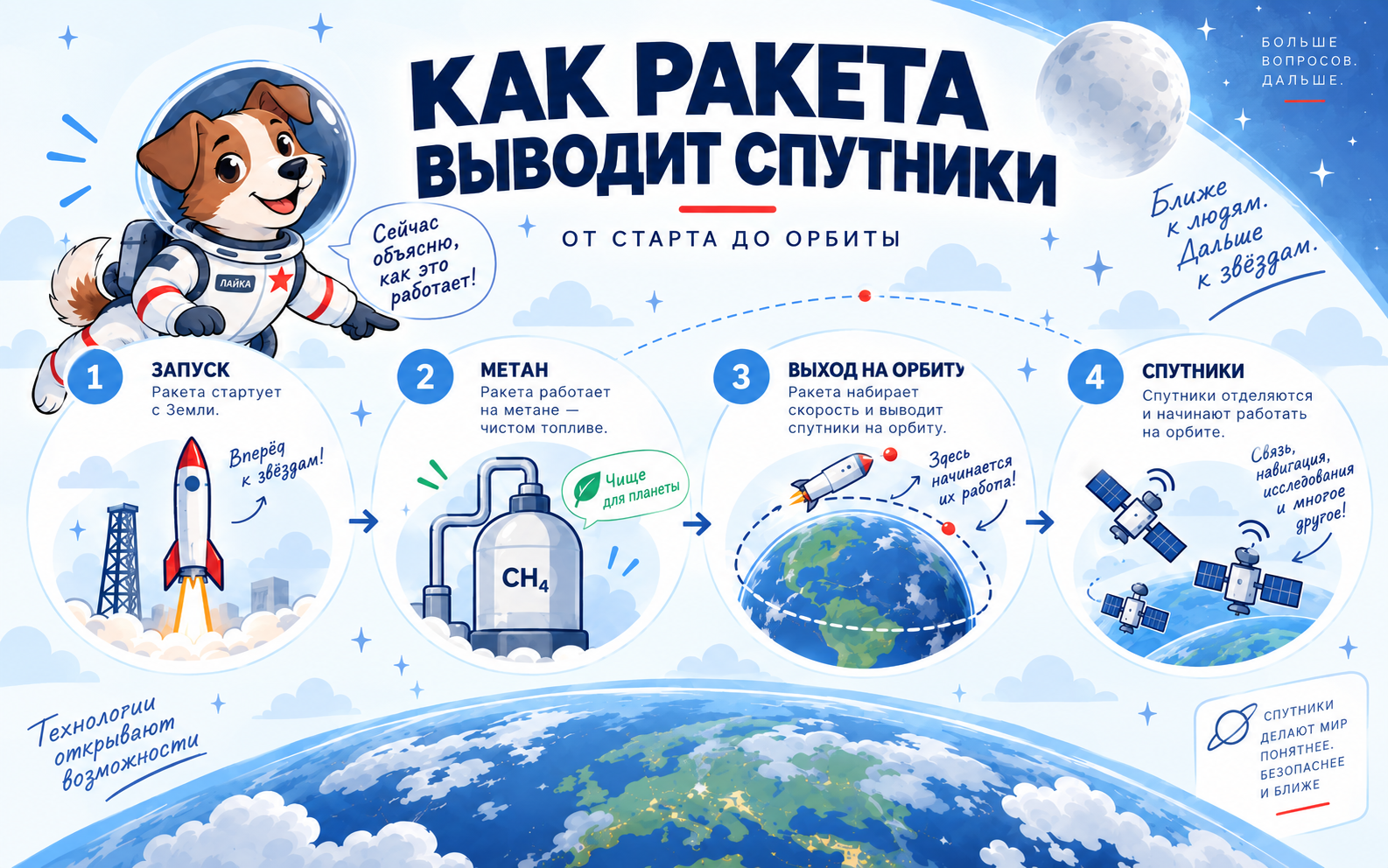
On September 15, 2026, Chinese private company LandSpace launched Zhuque-2E Y7 and placed ten satellites of the Qianfan constellation into orbit. At first glance, it is another commercial launch. For methane rockets, however, it shows something more important: a technology that was an experiment only recently is beginning to become a working tool.
Zhuque-2 holds a special place in spaceflight history. In July 2023 it became the first liquid methane and oxygen rocket to reach orbit. Now an improved version of the family is flying multi-satellite missions and is no longer launching merely to set a technical record.
What happened
Zhuque-2E Y7 lifted off from the Dongfeng commercial space zone at 14:26 Beijing time. On board were ten satellites of Qianfan’s 19th polar group. All spacecraft were delivered to their planned orbits.
It was the ninth flight for the Zhuque-2 family. LandSpace also called the mission the first large-scale deployment of satellites for an internet constellation by a Chinese private commercial rocket. In other words, this was no longer a demonstration: the launcher was entrusted with serial payload for a large orbital system.
Why everyone is talking about methane
Most well-known rockets of recent decades have flown on kerosene, hydrogen or solid propellant. Methane long remained a promising but relatively rare alternative. That is changing now.
Liquid methane is used in a rocket engine together with liquid oxygen. The combination is especially interesting for future reusable systems. Methane burns cleaner than kerosene and leaves fewer carbon deposits inside the engine. For a stage intended to fly again, that potentially means less work between flights.
Methane is also denser than hydrogen, so it needs less bulky tanks. Storing it is simpler than working with liquid hydrogen, which must be kept at an even lower temperature.
What exactly does “first” mean?
The phrase “first methane rocket” needs clarification. Zhuque-2 was not the first rocket in which engineers ever tried to use methane. Methane engines and launch vehicles were being developed in parallel in several countries.
Its historical achievement is more specific: on July 12, 2023, Zhuque-2 became the world’s first liquid-oxygen and liquid-methane rocket to successfully reach orbit. That is why today’s commercial flights of this line are particularly interesting: they show what happened to the technology after the first successful experiment.
Zhuque-2E is not reusable yet
Methane is often associated with reusable rockets, but one does not automatically imply the other. Zhuque-2E remains a two-stage expendable launcher. Its first stage does not return to the launch site after flight.
For LandSpace, however, this rocket is a technological step toward the next generation. The company uses shared solutions between Zhuque-2E and the Zhuque-3 under development, including engine technology. Zhuque-3 is being designed as a reusable system.
The logic is practical: the operational Zhuque-2E can accumulate experience in manufacturing, operations and regular launches, while proven solutions are later transferred to the returning rocket.
Why ten satellites matter
Against launches that carry dozens of spacecraft under one fairing, the number ten does not look like a record by itself. The mission matters for another reason.
A rideshare launch requires predictable launcher performance and precise insertion. For a satellite-system operator, an impressive one-off launch matters less than the ability to repeat such missions again and again. That is what separates an experimental rocket from a commercial transport vehicle.
If a launcher can regularly send batches of spacecraft, it becomes part of the production chain of a satellite constellation. Here, launch cadence matters no less than the rocket’s specifications.
Why Qianfan needs so many spacecraft
Qianfan is a Chinese low-Earth-orbit satellite communications system. Constellations like this are built not around a few enormous satellites, but around large numbers of relatively small spacecraft in low orbit.
Low orbit reduces signal latency, but creates another problem: a single satellite quickly passes over any particular point on Earth. To keep a connection continuous, another spacecraft must take over. A complete system therefore needs hundreds and eventually thousands of satellites.
As a result, manufacturing the spacecraft is only half the job. They also have to be launched quickly and regularly. That creates demand for launchers capable of serial multi-satellite missions.
What changes for spaceflight
In 2023 the main question was simple: can a methane rocket reach orbit at all? Zhuque-2 answered yes.
Now the question is different: can such a system become ordinary commercial transport? The Zhuque-2E Y7 launch shows that this transition has begun. The rocket has regular work, a multi-satellite payload and a place in the infrastructure of a large orbital program.
This does not mean methane will automatically displace kerosene or hydrogen. Different fuels retain their strengths, and launch economics depend on much more than the engine. But one thing is already clear: the methane architecture is no longer a rare engineering experiment.